Throughout history, many figures have left a mark on the world not only through their political power but through their principles and values. One such figure is Cato the Younger, a Roman statesman and philosopher who remains a monumental symbol of honour, justice, and resistance against bullies. You may know him as a fierce protector of traditional Roman values, a conservative stalwart, and maybe even an elitist whose words and deeds echo through the ages. But to reduce Cato to just those categories overlooks a critical aspect of his character: a passionate hatred of bullies.
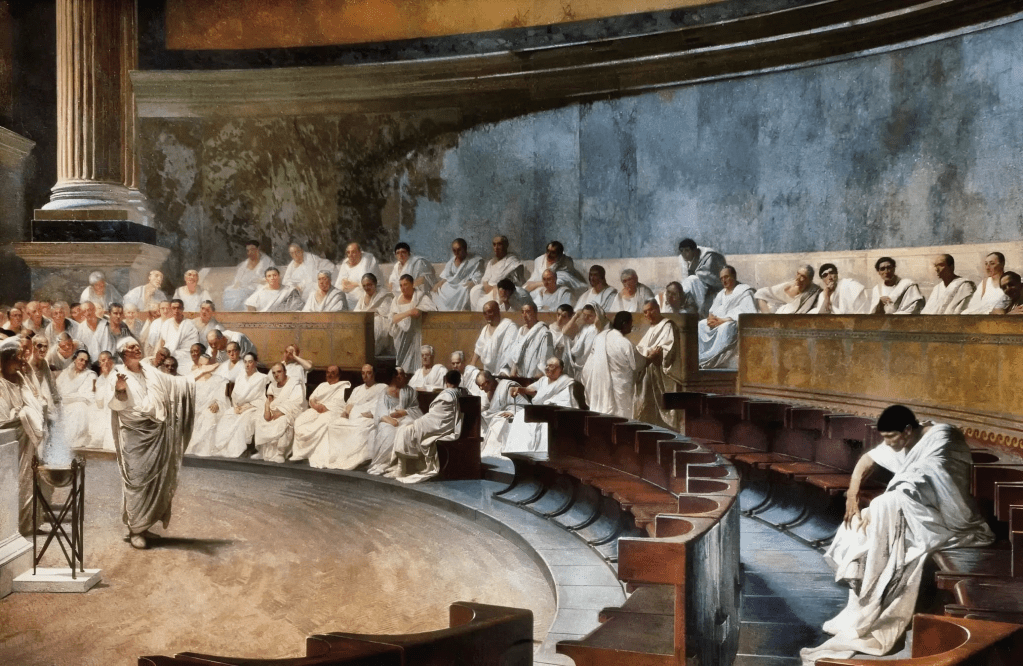
The story goes that as a young boy, Cato was at a birthday party for a friend. Like any kid, he’s full of energy and enthusiasm, but the fun turns sour when some older boys playing a cruel trick, trap a younger child in a dark chamber as a form of cruel entertainment. The frightened boy calls out for help, his voice trembling in the dark, and who comes to his rescue? Cato, of course. He doesn’t hesitate; he throws aside the boy blocking the door and leads the scared child back to safety. This act of bravery showcases an essential part of Cato’s character that would stick with him throughout his life: a fierce commitment to justice and protection of the weak.
In his teenage years, Cato finds himself in the house of Sulla, the notorious dictator of Rome, a man whose legacy is tainted by terror and tyranny. As Cato listens to his tutor explain why everyone is afraid of Sulla, his expression shifts dramatically. There’s something in the air; the injustice stirs something deep within him. Outrage bubbles over, and he demands a sword to fight back. “Why don’t you give me a sword,” he says, “so that I could free my country from slavery?” At such a young age, Cato is already envisioning a world where the oppressed are liberated, where bravery overcomes fear.
Cato’s disdain for tyranny didn’t magically dissipate as he grew older; if anything, it intensified. He began to see the corruption infecting Rome and its provinces, observing how it victimised ordinary people who deserved so much better. For Cato and his fellow Stoics, the virtue of justice was like a northern star, guiding them toward a life spent in opposition to bullies and tyrants. They stood against anyone who tried to abuse power or intimidate those weaker than themselves. It is said that the phrase “sic semper tyrannis,” meaning “thus always to tyrants,” In contemporary language, it means tyrannical leaders will inevitably be overthrown can be traced back to Stoic predecessors like Scipio Aemilianus, reflecting the disdain for despotism that permeated Stoic philosophy.
Fast forward again, and we see how figures throughout history, including George Washington, drew inspiration from Cato. Washington openly modeled aspects of his life and his vision of America on Cato’s principles. In a significant address, Washington declared that his vision for the nation allowed “bigotry no sanction” and offered “persecution no assistance.” He was advocating for tolerance and love in the face of a society struggling with division and discrimination.
The message that Washington relayed was powerful: stand up for justice, fight against intolerance, and be there for the vulnerable. Even though neither Washington nor the Stoics were perfect in their endeavors (let’s not forget about their shortcomings, including the complexities of slavery), they offered us an enduring ideal to strive for, a society based on equal rights, laws, and freedom from oppression.
Cato’s voice from centuries ago speaks to us still today, reminding us that tyrants, bullies, and oppressors of all kinds are the real enemies of justice. There is no room for accommodation or tolerance toward those who seek to intimidate others or exploit the weak. Whether it’s the vicious online mob, an exploitative economic system, a belittling boss, or a government that manipulates and bullies its citizens, tyranny is still tyranny, and it poses a threat to us all.
So, what does this mean for us in our lives today? Cato’s sentiments urge us to rise above our individual differences. Forget party lines, societal class, and any perceived scenarios that might segregate us. Instead, we need to come together and speak out against abuses of power and injustices, regardless of where they come from.
When we see the meek and vulnerable being scapegoated or mistreated, we can’t afford to look the other way. It’s on us to stand up against hate, violence, aggression, and cruelty. If we don’t advocate for the marginalised and vulnerable, then who will? And what does it say about us as people if we allow others to be hurt, exploited, or left to suffer in silence?
As we ponder Cato’s legacy, we must remember that together, we can harness the strength of our collective voices to champion justice and humanity. This is not just an abstract ideal or lofty concept; it’s a call to action. Whether through advocacy, dialogue, or simply lending a helping hand to those in need, our choices today shape the society we create for tomorrow. Let’s make it one that Cato would be proud of.
In a world that persists in witnessing bullying, discrimination, and tyranny in various forms, channeling Cato’s spirit can lead us toward a path of resilience and justice. We stand on the shoulders of giants, and it’s time we use that strength to build a better future for everyone. So, let’s get out there, speak up, and strive to be the voice for those who desperately need it!
 The Blog
Leave a comment