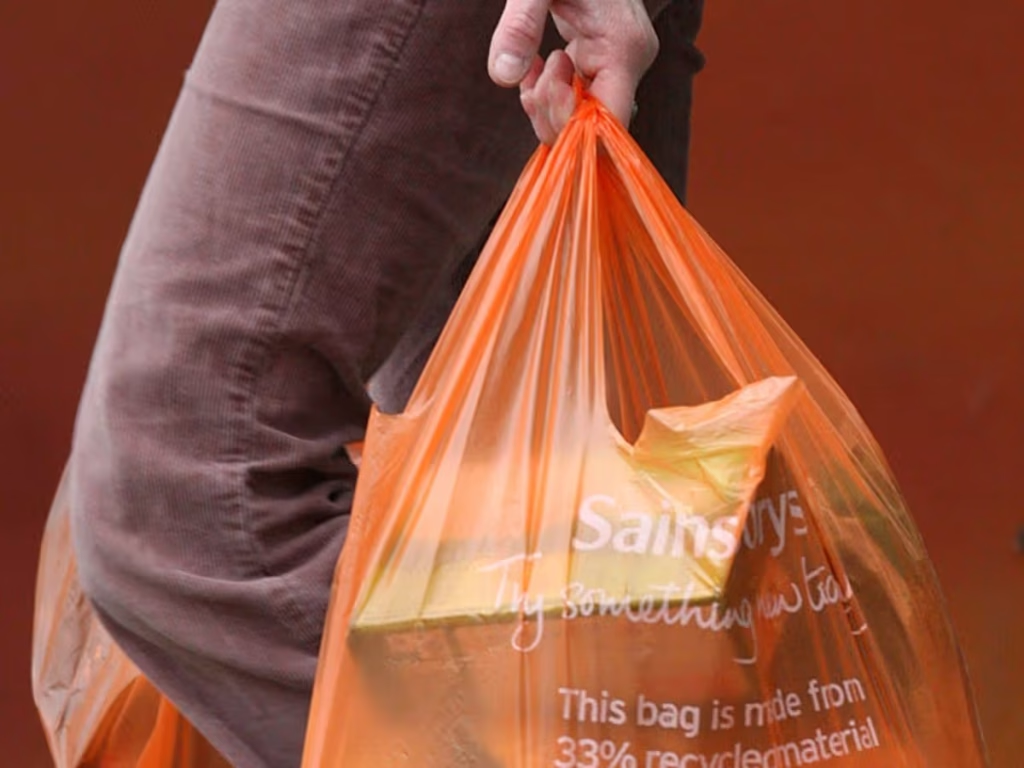
Modbury in Devon was the first town in Europe to ban plastic bags. In April 2007, following a campaign led by filmmaker Rebecca Hosking, every shop in the town voluntarily stopped providing single use plastic carrier bags. The decision was made without legislation, without government mandate, and without financial incentive. The shopkeepers of Modbury simply decided to stop.
The immediate effects were small. Modbury has a population of around 1,500 people. The plastic bags that would have been used in its shops in a year represented a fraction of a fraction of the UK’s total consumption. In quantitative terms, the change was negligible.
In every other sense, it was significant.
What Happened After Modbury
Within months of Modbury’s ban, towns across the UK and Ireland began announcing similar initiatives. The story had been picked up nationally, then internationally. The idea that a community could simply decide to stop using something, without waiting for legislation, had a clarity that resonated.
Ireland had introduced a plastic bag tax in 2002 that reduced consumption by around 90 per cent within a year. But a tax is a government intervention. Modbury was something different: a community acting on a shared decision about what kind of place it wanted to be.
The UK plastic bag charge, introduced in England in 2015, drew directly on the evidence from Ireland and on the cultural shift that Modbury and the towns that followed it had contributed to. By the time the charge came into force, the argument for it was already largely won. The behaviour change was already underway. The legislation formalised and accelerated something that had begun as a community decision in a small Devon market town.
The Mechanism of Change
The Modbury story is useful not because of its direct environmental impact, which was minimal, but because of what it demonstrates about how behaviour change actually happens.
It did not begin with legislation. It did not begin with economic incentives. It began with a person who cared about something, a conversation she had in her community, and a decision that the people in that community made together.
The decision created a fact on the ground. The fact on the ground created a story. The story spread. Other communities made similar decisions. The accumulated decisions created political conditions in which legislation became possible. The legislation created the economic conditions in which behaviour change scaled.
That is a long chain of causation. But it begins with the Modbury shopkeepers deciding to stop handing out plastic bags.
What Has Changed Since
The UK has banned single use plastic bags, straws, stirrers, and cotton bud sticks. Cutlery, plates, and expanded polystyrene food containers were added to the ban in 2023. The direction of travel is clear, and each new category that is banned was, not long before, considered an unrealistic target.
The plastic bag charge reduced consumption in England by around 95 per cent between 2015 and 2020. That is not a marginal improvement. It is a near elimination of a behaviour that had seemed entirely normal and largely invisible to most people five years before.
The reduction in visible plastic litter on beaches and in waterways that followed the charge is documented and significant. The National Trust, the RSPB, and local coastal monitoring groups have all recorded improvements in the years since.
None of this is complete. Single use plastic continues to be produced at enormous scale. The categories covered by legislation represent a small proportion of total plastic consumption. The systemic changes required to address the problem at its source, the reduction of plastic production rather than just the management of plastic waste, have not yet been made.
But the trajectory is different from what it was in 2007 when Rebecca Hosking drove to Modbury with footage of albatrosses feeding plastic to their chicks and asked her neighbours if they wanted to do something about it.
They did. And that turned out to matter.
Leave a Reply